
Processing a single bank statement isn’t too much of a issue. Manual entry is simple when just one PDF is needed.
This task can be multiplied over hundreds of businesses, many accounts, and many statement intervals.
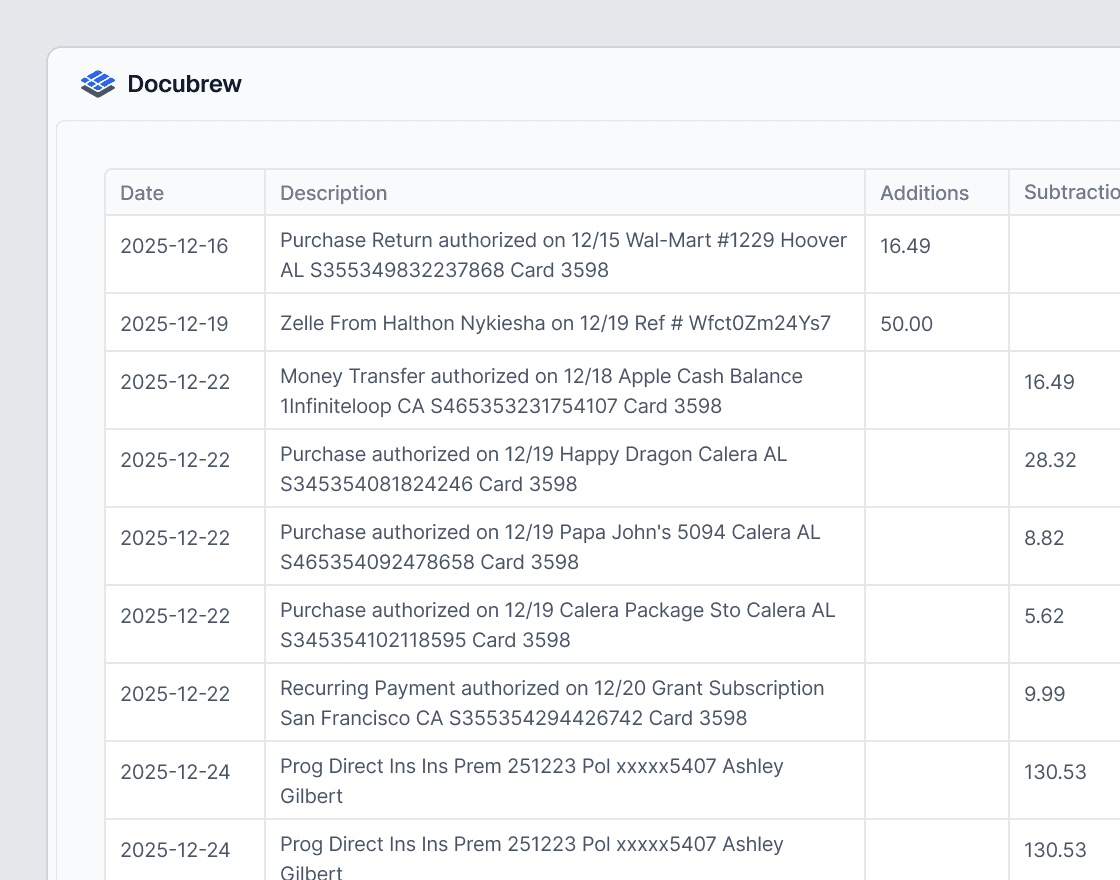
Image credit: docubrew.com
The issue has evolved. Once, it was a simple job for a clerical worker, but now it’s a long-winded process which consumes time of staff and increases the chance of inaccurate data entry. For bookkeeping and accounting businesses, improving bank statement conversion isn’t just about improving the speed of one document. It’s about developing a process that is still effective when volumes increase.
The bottleneck is repetition
Think about an accounting company receiving monthly PDFs from several clients. One client is sending statements from Chase and another from Wells Fargo and others Bank of America, Capital One or Citi.
The process of opening each PDF and entering each transaction manually requires repeating the same manual work again and again.
A converter for bank statements will change the process away from transcription to more of a review. Docubrew extracts the transaction figures directly from bank statements, instead of estimating the financial value. The result is a well-organized file that can be scrutinized prior to being used. As document volumes increase, this distinction becomes even more crucial.
Batch Processing Modifies Equation
Handling files individually may be acceptable for occasionally needed conversions. Accounting firms typically have to contend with a completely different situation. Docubrew allows for multiple documents to be transferred and processed in a single session, and the results that are available separately. Firms can now work through client records without having to manually rebuild each transaction table.
If the accounting workflow requires CSV files, users can convert bank statements to CSV and review the resulting transaction data before moving forward.
Scanned paper reports aren’t exempt from scanning. Docubrew comes with OCR for PDFs that are scanned, which can be helpful if clients’ historical records contain the combination of native PDFs and scans.
Create outputs for the Accounting Work Ahead
The process doesn’t finish with the conversion. Most transactions have to be routed somewhere.
Docubrew can export CSV as well as Excel. QBO is a choice for a team that needs to export a bank statement into Quickbooks. It’s also available in a general spreadsheet format.
Companies that frequently convert bank statements into Quickbooks will be able to create a more regular process for receiving statements, processing them, checking the information extracted and creating the proper data files to support the accounting workflow.
Human review is essential. Automation can eliminate repetitive transcription, but bookkeepers must still be accountable for reviewing financial data and making sure that they are doing the accounting task accurately.
Client Data Should Be a Part of Its Own Workflow The Client Data Deserves Its Own Workflow
The handling of sensitive client information is also related to higher volumes of documents.
Docubrew has two methods of processing. Windows desktop software performs conversions locally. The files can be saved to the computer. The cloud option uses encrypted uploads, and Docubrew states that the uploaded and converted files are automatically deleted within 24 hours.
Accounting practices can select the method that best suits their internal needs.
Scale-based Processes, not Repetitive Work
A booming bookkeeping business should anticipate more financial records. It shouldn’t automatically accept proportionally more copy-and-paste.
The question to ask is whether the process that was successful for five clients will still be effective for 50 clients.
Through standardizing the process of receiving, converting, reviewing, and preparing accounting statements software, companies can create an automated workflow for the production of recurring quantities rather than treating each new PDF like the manual work.